Sleep Basics · Mattress 101
What to Look for in an Organic Crib Mattress
A crib mattress is a quiet piece of equipment with an unusually serious job. Choosing an organic model means looking beyond reassuring words on a label to the things that matter every night: a snug fit, a firm and flat surface, clearly described materials, and care instructions a household can realistically follow.
There is a particular kind of attention that settles over a nursery before a baby arrives. A drawer is lined, a small stack of clothes is folded, and the crib—an object of sensible dimensions, until it becomes the setting for a whole new life—is assembled with care. The mattress can seem like the least dramatic part of the room. It is also one of the most consequential choices.
For caregivers considering an organic crib mattress, the word organic may suggest a straightforward promise about what is inside. In practice, it is only a starting point. Products can differ in the materials used in their covers and cores, how those layers are assembled, what a certification applies to, and whether the mattress can be cleaned or maintained as intended. Those details deserve a patient look.
Safety comes first, and it is not interchangeable with a marketing claim about natural or organic materials. A crib mattress should fit its crib snugly and provide a firm, flat sleep surface. Caregivers should follow current safe-sleep guidance from recognized health and safety authorities, as well as the instructions for the specific crib and mattress. Organic materials do not make a mattress safer by themselves, and no material label substitutes for correct fit, appropriate use, and regular inspection.
This guide is designed to make comparison less mysterious. It offers practical questions to ask about size, firmness, construction, certification, durability, cleaning, and manufacturer claims—without implying that any one material or label is right for every family.
Start with the crib, not the adjectives
Before comparing latex, cotton, wool, or other materials, confirm the mattress dimensions required by the crib. A mattress that is too small can leave a hazardous gap; one that is too large may not sit correctly in the frame. Standard dimensions are common, but caregivers should not rely on the word “standard” alone. Check the crib’s manual and the mattress specifications, including any stated limits on the crib’s size or mattress thickness.
When the mattress is in place, it should sit level and fit securely. The frame should not bow or force the mattress into a shape it was not designed to hold. Follow the crib manufacturer’s instructions for checking fit; do not improvise with rolled blankets, padding, or other objects to fill a space. If the fit is uncertain, stop using the setup until it has been checked against the manufacturers’ guidance.
Thickness matters for more than appearance. A mattress that is unusually thick may affect how the crib’s sides and support settings function. The permitted mattress thickness is specified by the crib manufacturer and may also be addressed in the product documentation. Keep those instructions available after assembly; they are more useful than a retailer’s shorthand description.
- Confirm the crib’s interior dimensions and the mattress size listed as compatible.
- Check the mattress thickness against the crib manual.
- Verify that the mattress rests flat, without bending or rocking in the frame.
- Use the mattress support and height settings only as directed by the crib manufacturer.
- Recheck the fit if the mattress is replaced, the crib is converted, or a different support setting is used.
Fit is not a glamorous feature, and it does not photograph particularly well. It is nonetheless the first test a crib mattress has to pass.
Firmness and a flat sleep surface
Adults often judge comfort by how much a surface yields. That instinct can lead to confused crib-mattress shopping. A baby’s sleep surface should be firm and flat, not plush, pillow-like, or deeply cushioned. A mattress marketed as “supportive” or “comfortable” should still be evaluated by its intended use and the applicable safety information, rather than by a soft showroom feel.
Firmness can be difficult to compare because product descriptions do not always use the same scale. A seller may use terms such as “extra firm,” while another provides no rating at all. Treat those labels as descriptions, not as a universal measurement. Review the manufacturer’s documentation for the crib-mattress model, and look for clear statements about its intended use and applicable safety standards.
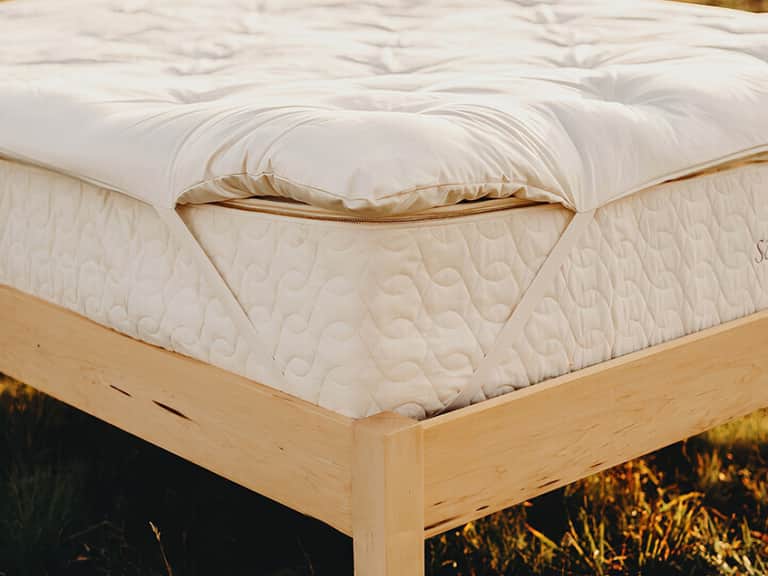
A flat surface means a level surface without built-in contouring, depressions, raised cushions, or positioning features. Avoid adding a topper or extra padding to make the mattress softer. A separate pad may alter the sleep surface or interfere with fit, and should not be used unless the crib and mattress manufacturers specifically permit the accessory and it is consistent with current safety guidance. In particular, an adult mattress topper is not a substitute for a crib mattress.
Keep the sleep setup simple. The mattress should be covered only with a fitted sheet that is made for the mattress, fits snugly, and is intended for crib use. Loose bedding, pillows, comforters, and plush objects do not belong in an infant’s sleep space. For individualized concerns about an infant’s sleep, consult a qualified health professional rather than attempting to solve them with a softer surface or added positioning product.
What “organic” does—and does not—tell you
Organic is a useful word only when it is attached to specific information. It may refer to a particular fiber, such as cotton, rather than to every component of the mattress. A mattress can combine a fabric cover, batting, a core, adhesives, seams, and other elements; a claim about one layer does not automatically describe the entire construction.
Look for a materials list that names each major component and explains where it appears. Is the cover organic cotton, or is the core also made from a stated organic material? What is used for cushioning? Is there a waterproof layer? If the product includes a fire barrier, what is it made of? The goal is not to assume that any single material is desirable or undesirable, but to understand what the product actually contains.
Specific descriptions are more useful than broad assurances. “Natural,” “green,” “eco-friendly,” and “non-toxic” can be persuasive, but they do not by themselves define a product’s composition or establish that a particular standard has been met. Ask whether the language applies to the whole mattress or only to a cover, fiber, or other component. If a manufacturer does not explain the scope of a claim, treat that as an unanswered question, not as proof of a problem.
It is also helpful to distinguish material origin from safety performance. An organic material description does not, on its own, establish that a mattress meets every requirement applicable to crib use. Conversely, the presence of a synthetic component does not by itself tell you whether a mattress complies with relevant requirements. Make decisions using the complete documentation: intended use, applicable standards, construction, and fit.
Families may also have personal preferences concerning animal-derived fibers, agricultural practices, or environmental impact. Those are reasonable considerations, but they are separate questions from whether a product is appropriate for a crib. A clear description of sourcing and processing can help caregivers decide whether the materials align with their priorities.
Read certifications as carefully as the claims
Independent certification can add useful context, but the certificate’s name is only the beginning of the inquiry. Find out which organization issued it, which product or component it covers, and what the certification evaluates. Some programs focus on the origin of a material; others may assess emissions, chemical content, or processes. One certificate should not be assumed to cover every concern.
Check the exact model and the current status of the claim. A company may describe a line as certified when the documentation applies only to a particular fabric or material. A certificate for the cover, for example, is not necessarily a certificate for the finished mattress. Look for a model-specific record, a certificate number, or an explanation from the certifying organization. When information is unclear, contact the manufacturer and ask for the scope in writing.
Certification marks should not be treated as medical guarantees. They do not mean that a product prevents allergies, improves sleep, or eliminates every possible exposure. Nor do they replace the need for a safe, compatible crib setup. Their value lies in the defined checks they represent, within their stated limits.
A useful way to read any environmental or material claim is to ask three questions: What exactly is being claimed? Which part of the product does the claim cover? Who verifies it, and where can the verification be checked? If the answer is precise and traceable, the claim is easier to evaluate. If it dissolves into vague language, keep comparing.
Understand the construction, layer by layer
A crib mattress is not simply a material poured into a rectangle. Its feel and function emerge from a combination of layers and their arrangement. The cover, core, cushioning, seams, and any moisture-resistant barrier may all influence firmness, weight, ventilation, durability, and care. A useful product description should make this structure legible.
Foam models may vary in density and formulation. Innerspring models contain a support system whose design and surrounding layers affect the finished product. Natural-fiber mattresses may use materials such as cotton or wool in particular layers, sometimes alongside other components. These broad categories do not determine quality by themselves. Construction details and documentation matter more than a material name used as a headline.
Ask whether the core is one piece or built from multiple layers, how the cover is attached, and whether the cover can be removed. Find out whether the product is designed to be used on either side, and whether the manufacturer provides different firmness levels for different stages. Never assume a mattress is reversible simply because both faces look finished; follow the specific model’s instructions.
Some mattresses are marketed as dual-sided, with a different surface for an infant and an older child. If considering one, read how each side is identified and when the manufacturer says to change surfaces. The crib must still be used within its stated limits, and the mattress should be checked for secure fit after any change. A feature that seems convenient is worthwhile only when its use is explicit.
Weight can also be practical. A mattress that is easier to lift may simplify sheet changes and routine cleaning, while a heavier model may feel substantial but require more effort to handle. Weight should not outweigh safety, fit, or material clarity; it is simply one of the everyday realities worth considering before the mattress arrives.
Care, spills, and the limits of “easy to clean”
Care instructions are easy to postpone until the first spill, which is precisely when they become important. Some crib mattresses have removable covers; others are intended to be wiped clean. Some materials can be damaged by soaking, harsh cleaners, heat, or machine washing. Before buying, find the manufacturer’s instructions for the complete mattress and for any removable component.
“Waterproof” can describe a surface barrier, but it does not explain how that barrier is constructed or whether it can be cleaned in a particular way. Ask what is protected, whether the cover is removable, and what cleaning products are allowed. Never assume that a mattress can be immersed or put in a washing machine. Moisture trapped in layers may take a long time to dry and could affect the mattress.
Caregiver priorities differ. A removable, washable cover may be convenient, but the design must still fit securely and be reinstalled exactly as directed. A wipe-clean surface may offer a simpler routine, while a fabric cover may suit households that prefer a particular textile. The useful question is not simply “Which is easiest?” but “Can we maintain this product safely and consistently?”
- Read the cleaning directions before purchase, not only after delivery.
- Confirm whether the cover comes off and whether it can be washed.
- Check restrictions on detergents, disinfectants, heat, and drying.
- Ask how to handle moisture or an accident that reaches the mattress interior.
- Use only accessories and fitted sheets that are compatible with the mattress.
Protective accessories can also affect the surface and fit. Before adding a waterproof protector or pad, check that it is intended for crib use and permitted by the crib and mattress manufacturers. Do not layer products simply because each is described as thin or breathable. The finished sleep surface—not the accessories considered one at a time—is what matters.
Durability and the questions behind a long warranty
A crib mattress may be used for years, passed between siblings, or stored for a later child. Durability is therefore more than a promise of good stitching. It includes how the core holds its shape, how the cover tolerates cleaning, whether seams remain intact, and how the product should be inspected over time.
Read the warranty, but do not let its length stand in for a quality assessment. A warranty may exclude ordinary wear, stains, damage from improper cleaning, or changes in feel. Check what it actually covers, how a claim is made, and whether proof of purchase or a product registration is required. Ask whether the warranty is tied to the original purchaser or can be transferred.
For a mattress intended to be reused, follow the manufacturer’s instructions for storage and inspection. Look for damage, broken seams, a compromised cover, sagging, or a surface that no longer lies flat. Do not use a mattress that is damaged, visibly deteriorated, or no longer fits the crib correctly. If the history of a secondhand mattress is uncertain, consult current safety guidance and the product documentation before deciding to use it.
A mattress can look clean and still have a less obvious problem, such as a weakened structure or an incompatible dimension. Conversely, a small cosmetic mark does not automatically tell the whole story. The manufacturer’s stated criteria for continued use, together with current safety recommendations, provide a better basis than appearance alone.
How to evaluate manufacturer claims
The marketplace has a talent for making every product sound like a discovery. Organic fibers are described as pure; foam is said to breathe; a cover is called antimicrobial; a design promises a better night. Some statements describe verifiable features. Others are promotional language. A careful reader separates the two without assuming that marketing language is either proof or deception.
For each claim, look for a concrete explanation. “Made with organic cotton” should identify the component and, ideally, the basis for the claim. “Low emissions” should indicate what was tested and by whom. “Hypoallergenic” should not be mistaken for a guarantee that a child will have no reaction. “Temperature regulating” may describe a material property, but it does not promise a particular sleeping temperature in every nursery.
Be cautious with absolute language: “chemical-free,” “completely safe,” or “non-toxic” can suggest more certainty than a product description can reasonably provide. All materials have chemical compositions; meaningful evaluation depends on the substances, exposure conditions, testing, and applicable standards. A manufacturer that explains its terms and shares relevant documentation is easier to assess than one relying entirely on sweeping assurances.
It is reasonable to contact a company with precise questions. Ask for the full bill of materials, the scope of a certification, the mattress’s intended use, the cleaning method, and the appropriate crib dimensions. The quality of the answer is itself informative. Clear, model-specific responses are more useful than generic language copied from a category page.
A practical comparison checklist
When several options appear similar, a short checklist can prevent a purchase from being driven by whichever feature has the most persuasive description. Keep the crib manual nearby and compare the exact mattress models, not just their product-family names.
- Compatibility: Does the mattress match the crib’s stated interior dimensions and thickness limits?
- Fit: Does the manufacturer explain how to check that the mattress sits snugly and flat?
- Firmness: Is it explicitly intended as a crib mattress with a firm, flat sleep surface?
- Materials: Are the cover, core, cushioning, and barrier described separately?
- Organic claims: Which specific materials are described as organic, and what documentation supports that description?
- Certifications: What does each certification cover, and can the exact model or component be verified?
- Care: How should the mattress and cover be cleaned, and what methods should be avoided?
- Construction: Is the mattress one-sided or dual-sided, and are its intended orientations clearly explained?
- Durability: What does the warranty cover, and what conditions require the mattress to be replaced?
- Returns: Can the mattress be returned if it does not fit, and what are the conditions for doing so?
A simple comparison table can help: list each model across the top and the questions down the side. Record facts, not impressions. If the product page does not answer an important question, note it and ask the manufacturer. A slightly less poetic description can be the more useful one.
Common assumptions worth setting aside
“Organic means safer.” Organic sourcing may matter to a family, but it is not a substitute for checking crib compatibility, firmness, fit, construction, and applicable safety information.
“Natural means chemical-free.” Natural materials are still materials with chemical properties, and finished products may contain several kinds of components. Ask what is present and how claims are substantiated rather than relying on a broad category word.
“More cushioning means more comfort for a baby.” Adult ideas about plushness do not set the standard for an infant sleep surface. The crib mattress should be firm and flat, and extra padding should not be added to change its feel.
“A certificate covers the whole mattress.” It may cover only a component or a defined set of criteria. Read the scope and verify that it applies to the model under consideration.
“Waterproof means washable.” A moisture-resistant surface does not necessarily mean the cover can be removed or the mattress can be laundered. Follow the product’s actual care instructions.
“One mattress fits every crib.” Dimensions and thickness limits matter. Confirm compatibility for the specific crib rather than relying on a general size name.
Making a calm, well-informed choice
There may be a temptation to search for one perfect material, as if cotton, wool, latex, foam, or springs could settle every question at once. But a material preference is only one part of the decision. The more dependable approach is to begin with the crib’s requirements, confirm a firm and flat sleep surface, understand the mattress construction, and then assess organic claims in their proper scope.
Caregivers can bring different values to the search. One may prioritize a particular fiber; another may care most about a washable cover, a lighter mattress, a clear certification, or the ability to reuse the product. These priorities can coexist, provided they do not displace the essentials of safe fit and intended use. It is also perfectly reasonable to choose a product with a straightforward materials description over one with a more impressive list of adjectives.
Keep the product label and instructions after purchase. They can be useful when washing a cover, changing a crib setting, evaluating a warranty, or checking whether a mattress remains suitable for use. Revisit the instructions when the crib changes configuration; recommendations for one stage or setup should not be assumed to apply to another.
Finally, remember that a mattress is one part of a sleep environment. Follow current safe-sleep recommendations for the infant’s age and circumstances, and speak with a pediatric clinician about individual health questions. No mattress, organic or otherwise, can promise uninterrupted sleep or remove every uncertainty of early parenthood. What it can do is provide a well-chosen, properly fitted, firm and flat foundation—quietly, night after night.
Frequently asked questions
Does an organic crib mattress need a special sheet?
Use a fitted sheet designed for the mattress dimensions and intended for crib use. It should fit snugly. Do not add loose bedding or use an adult sheet that can bunch or come free. Check the mattress and crib instructions for compatibility.
Can a mattress topper make a crib mattress more comfortable?
A topper changes the sleep surface and may affect fit. Do not use one unless the crib and mattress manufacturers explicitly permit that specific accessory and its use is consistent with current safe-sleep guidance. Adult toppers are not designed as substitutes for crib mattresses.
Should I choose a mattress with a removable cover?
A removable cover may be convenient, but check how it is cleaned, whether it must be reinstalled in a particular way, and whether it is included in the product’s safety and material documentation. Convenience should not come at the expense of a snug fit or correct use.
How can I tell whether an organic claim is meaningful?
Look for the component named, the scope of the claim, and documentation that identifies the certifying organization or standard. Ask whether the claim applies to the cover, the core, or the complete mattress. A clear, verifiable explanation is more helpful than a general “natural” or “eco-friendly” label.
When should a crib mattress be replaced?
Follow the manufacturer’s replacement guidance. A mattress should not be used if it is damaged, sagging, no longer lies flat, has a compromised cover or seams, or fails to fit the crib correctly. For a used mattress, consider its condition and history and consult current safety recommendations before use.